
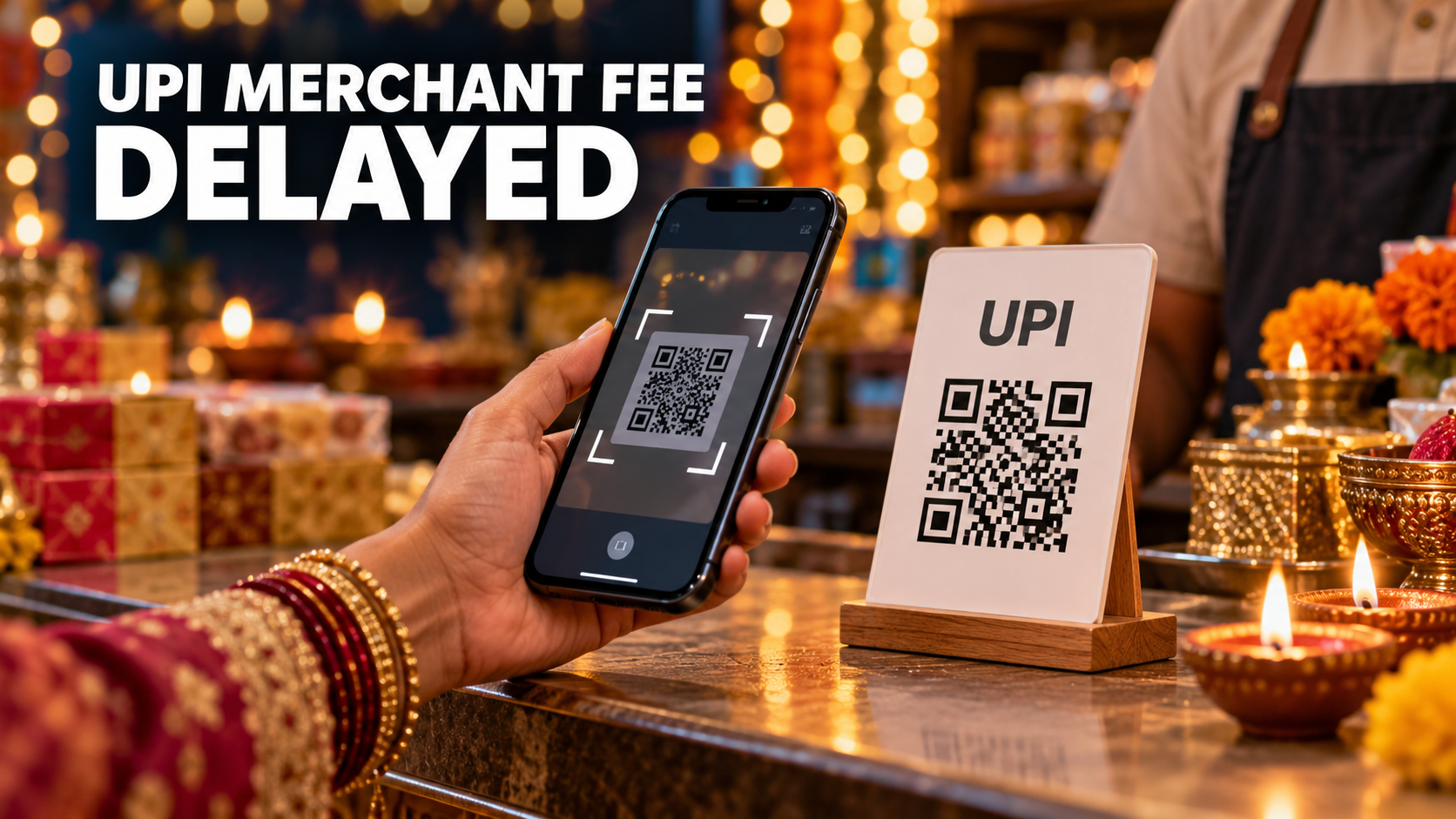
India has postponed the October 15 rollout of a 0.4% merchant fee on eligible UPI payments above ₹2,000 until after Diwali. The National Payments Corporation of India announced the decision on October 13, giving businesses relief ahead of the festival shopping rush. The charge aims to target merchants that accept qualifying payments, with no automatic deduction for every customer who crosses that transaction threshold.
NPCI cited the festive season as the reason for the deferment. Retailers had opposed the timing because a new payment-processing expense could squeeze margins during one of their busiest sales periods. The Confederation of All India Traders welcomed the decision as “timely and pragmatic” after around 20 trade representatives met the finance minister on September 30.
NPCI approved the structure on September 15, allowing banks, payment aggregators and other participants a month to prepare their systems. However, merchant associations subsequently sought a January introduction. They argued that additional costs could weaken festive sales.
The proposed charge, or merchant discount rate, pays participants that process online transactions. Banks, payment service providers, and UPI applications would share that revenue. The Finance Ministry has clarified that MDR does not constitute a government tax. Policymakers want the proceeds to support the network’s continued operation and expansion.
What customers and merchants need to know about the UPI Fee
Will the customers pay extra for sending ₹2,500?
For a qualifying shop purchase, the standard calculation would produce a ₹10 merchant processing charge once implementation commences. The payment would remain ₹2,500. But merchants cannot recover MDR from customers, and the government prohibits UPI application providers from imposing platform fees or hidden charges on these transactions.
Does this affect person-to-person transfers?
No. Sending money to another individual remains free irrespective of the transfer amount. The government has also ruled out monthly quotas or tiered charging bands for individual users. Meanwhile, the banks and NPCI will maintain daily transaction limits for security and risk management, but those limits will not set a threshold beyond which users must pay fees.
For merchants, the postponement will preserve existing arrangements until the revised launch. Even after implementation, payments of ₹2,000 or less will carry zero MDR.
Other than that, small vendors who receive up to ₹1 lakh monthly through UPI QR codes under NPCI’s person-to-person-merchant category will also retain their exemption. The Finance Ministry estimates that roughly 96% of merchant transactions will avoid the new levy.
The standard percentage would reach its ₹300 ceiling on a ₹75,000 transaction, and higher qualifying payments will attract no additional MDR beyond that cap. Businesses therefore need to check both their merchant classification and the applicable transaction category when estimating their payment costs.
Not to mention, separate rates also apply to certain services. For example, payments above the point in categories including railways, telecom, insurance, fuel and agricultural inputs will have a flat ₹5 merchant charge.
On the other hand, capital-market payments will carry a lower 0.02% rate, subject to the same maximum cap. NPCI will also exempt mutual fund SIP payments and recurring UPI standing instructions, including qualifying utility and subscription payments.
When will the rule begin?
NPCI says implementation will follow “immediately after” Diwali, which falls on November 8 this year, but it has not announced an exact replacement date.
In the meantime, merchants may want to use the additional preparation time to confirm settlement arrangements with their payment providers and review how the relevant exemptions hold to their businesses.
Stay tuned to Kine News for more such news.